HBL topic: Territorial acquisition
HBL #138895
09/17/21
As mentioned in several of my previous posts on the subject, I advocate buying land in a localized area, on an edge of a host country. The land will be initially used for vacation, and eventually will be developed enough for full-time living. Combined with a pro-capitalism propaganda, the zone will attract more people seeking freedom. Eventually, the capitalist view will get national attention. All these factors will make it more likely to establish an autonomous economic zone.
This is similar to the Free State project. The only difference is that the ideology will be capitalism instead of libertarianism. The Free State people encourage gun ownership and going off-grid. I applied to their Facebook group and was rejected, undoubtedly for “wrongly” answering their questions about weapons.
HBL #138972
09/25/21
Aquinas Hobor says that it’s unlikely that a country would give up sovereignty of a territory. But we do have historical precedents. Circa 200 BCE, the Roman Republic freed Greece after consul Titus Quinctius Flamininus beat the Macedonian king Phillip. Will Durant writes in “Caesar and Christ,” Book 1, Chapter 4:
“[Flamininus] was a youth of thirty, one of that liberal Hellenizing circle which was gathering about the Scipios in Rome. After some careful maneuvering he met Philip at Cynoscephalae and overwhelmed him (197). Then he surprised all the Mediterranean nations, and perhaps Rome, by restoring the chastened Philip to a bankrupt and weakened throne, and offering freedom to all Greece. The imperialists in the Senate protested; but for a moment the liberals predominated, and in 196 the herald of Flamininus announced to a vast assemblage at the Isthmian games that Greece was to be free from Rome, from Macedon, from tribute, even from garrisons. So great a cheer rose from the multitude, says Plutarch, that crows flying over the stadium fell dead. When a cynical world questioned the sincerity of the Roman general he answered by withdrawing his army to Italy. It was a bright page in the history of war.”
This is a clear case of ideas driving history. The conqueror sympathized with Greek ideas (he was part of the Scipios’ intellectual club), so he granted it freedom.
A present case is the peaceful thirty-year-old campaign for separation of Quebec, lead by the Bloc Québécois party. Thus, it is possible to peacefully campaign for sovereignty. Although Quebec has not yet seceded, the issue has received national attention. This is the kind of attention we wish Objectivism and the campaign for laissez-faire capitalism had.
Onto the next point: Aquinas Hobor suggests Point Roberts peninsula as a prospective location. He says that Canada wished, yet was unable, to achieve sovereignty over the peninsula. I am not aware of any dispute regarding Point Roberts. Having Point Roberts on USA soil is a boon to Canadians. The border crossing is more lax there since it does not allow Canadians to drive into the mainland USA. I live in Vancouver, Canada and Point Roberts is an hour drive from my house. Many locals regularly drive there to pick up Amazon packages and fill up gasoline tanks. I have met one guy who lives in Point Roberts and works in downtown Vancouver. He told me that crossing that border on a daily basis is no hassle for regulars.
The main downside with Point Roberts for the purpose of a laissez-faire centre, is that it is too small for a country. Otherwise it has many other desirable properties I have mentioned. It has ocean access, it has good weather and good soil, it is in a civilized area, tucked between two first-world countries, and it is easily accessible to Americans.
This brings me to answer the question asked by Adam Reed, namely what are the downsides to the suggestion of the Swiss Canton as the prospective location. First, it is too far from United States, the country in which presently the majority of Objectivists live. I advocate gradual migration through a purchase of vacation property, and moving there permanently only when personal factors permit it. Until a permanent move, the cost of frequent travel becomes significant. Also, the time zone change would make short trips ineffective.
Second, the real estate in Switzerland is expensive, which makes it difficult to buy large lots of land. Land ownership would allow creation of gated communities in which members are vetted to be in favor of capitalism.
Third, the primary language in Switzerland is not English. It is difficult to change the philosophy of a country, if one doesn’t speak its language and cannot read the fine print on government forms.
There are three locations in North America that may work well. One is Point Roberts, second is Baja California, which Harry Binswanger suggested. Third is New Hampshire (but even better Maine, since New Hampshire cuts Maine off the rest of USA). New Hampshire is where Libertarians are going as part of the Free State project. This area was selected out of some twenty locations, according to the votes of thousands of subscribers to the Free State project.
I think Objectivists would gain out of collaboration with Libertarians in this case. It is true that some libertarians want anarchism, but they would never get it until they can secede from the host country. Short of anarchism, the libertarians are happy with laissez-faire. Also, propagandizing Objectivism in a small geographical region (rather than the whole country) has a higher chance to convert the local population.
HBL #139142
10/13/21
After reading this thread, I have become convinced that my original idea of slowly populating an area with people in favor of capitalism is not going to work. Because there are not enough people in this world who actually want capitalism, we would end up with a society favoring socialism.
This still leaves the possibility of forming a country first, with a constitution that protects capitalism and preempts socialistic bills. In order to put down civil riots, we would need to have enough policemen committed to the constitution. If a single policeman can ensure safety of a thousand-person neighborhood, then a country with only a thousand policemen cannot have more than one million people. Still, the country would not survive a civil war.
This brings me to a general point that immigration must be open only up to a capacity, like the number of people entering a popular night-club. If there are not enough policemen to secure safety, immigration must be stopped.
In light of the preceding, are there enough Objectivists in the world to guarantee a safe country? How many Objectivists should be in the police force and in the military to stop a civil war from occurring?
My biggest problem with Baja California is that it is hot, and a supply of fresh water is an issue. This increases the cost of settlement significantly. I think we should focus on a location with enough rain and sunlight.
HBL #139156
10/14/21
We could presell land in the future country in order to collect enough funds to buy out a piece of land from the host country (e.g., to buy Baja California from Mexico).
The ownership of real estate can be tracked using a blockchain with its own associated cryptocurrency. It would also track volume of free space above ground or under the ground. Such would allow an independent party to build an overpass or a tunnel under someone else’s house.
In the beginning of the project, it is dubious that we would be able to succeed, so the cryptocurrency value is low. As more money is collected, it becomes more realistic, so the cryptocurrency value will rise.
There should be a qualification that once the country is formed, the owners of the land must cultivate it within N years. Otherwise they forfeit their ownership.
An example of an existing cryptocurrency that tracks property is Namecoin. It tracks ownership of Internet domain names.
HBL #139212
10/18/21
In response to my idea to pre-sell land virtually using a dedicated cryptocurrency and a blockchain, Joseph Avatar writes that “each lot does not have the same value as the next.” Each lot of land would cost the same only initially, but it can be resold at different prices.
I have asked on the Namecoin’s IRC channel how a domain name is bought and sold. The registration of the domain ownership with the registrar is a fixed amount of 0.01 Namecoins, and ownership is represented as a special “coin” in one’s digital wallet. To transfer ownership of the domain, the current owner would send this special coin to another Namecoin digital wallet. For instance, if he wished to sell the domain name “dog.bit” for $15,000 USD to a willing buyer, he would wait until a wire arrives in his bank account, and then transfer the ownership.
However, there is an advantage to settle in Namecoin rather than in USD. This way the transfer can be done atomically. Since Namecoin trades at $1.5, the current owner would expect to receive 10,000 Namecoins as payment. Similarly, the buyer needs a guarantee that the seller would indeed relinquish the domain name upon receipt of said payment. IRC-user Yanmaani explains,
There’s also atomic name trading, where you make a transaction that sends namecoins to the seller if he sends you the [domain] name. This is done automatically, meaning there’s no risk or need to trust that he’ll hold up his end.
Similarly, I propose that real estate be tracked in a blockchain, and traded atomically for a dedicated cryptocurrency. Since the value of cryptocurrency is tied to real estate value, the currency value will also rise.
This cryptocurrency would become a funding source to purchase the overall territory of the country and other expenses to run the government initially. The potential government of the future country creates a company Acme Inc. The company creates a new cryptocurrency, let us call it ABC, and pre-mines 20% of the coins. It then sells real estate lots for 1 ABC, which causes people to either create new coins by mining or to buy them from Acme. After Acme sells 5% of mined coins, it retains 15% and does not sell them. When the cryptocurrency goes up sufficiently in value, Acme begins to dump its coins in exchange for USD, accumulating 2 billion dollars. It then proceeds to negotiate for the purchase of the country’s land. When the country becomes recognized, Acme transfers ownership of all funds to the newly established government.
The advantage of this scheme is an increased level of objectivity in the way ownership is represented, the ability for people from all corners of the world to participate and trade actively without involving Acme, and the gain from the rise of the cryptocurrency’s value. There will also be cryptocurrency traders who simply buy and sell the currency for speculation, without planning to buy real estate with it.
The scheme also helps with marketing the new free country to cryptocurrency traders, among whom there are many people who would find the project appealing.
Note that I am not the first one to apply Namecoin-like blockchain to property rights. A researcher Nick Szabo wrote a paper on this topic, titled “Secure Property Titles with Owner Authority.”
HBL #139222
10/19/21
Joseph Avatar asks if I am interested in cooperation on my cryptocurrency proposal. I’m interested in cooperation. This is because I already have another project in secure messaging that I am primarily committed to (outside of my day job that pays the bills). Furthermore, I am in general interested in maximum cooperation on the new country project, cryptocurrency or not. I hope to interest as many Objectivists in pursuing the idea.
The first stage of this cooperation is to find a plausible geographic territory. After reading the book on unusual country borders that Aquinas Hobor suggested, I have learned that it is not necessary that the new country be on a single piece of land. For instance, although Point Roberts alone is too small for a country, it can have exclaves such as Kunghit Island. Perhaps if a country is established on a territory small enough to fit one major city, it would be easier to obtain exclaves afterwards in order to host additional population.
Another idea from reading that book is that it may be possible to take over an exclave of some country, by convincing people who live in the exclave to go independent via a referendum. In the past, referendums were used to decide to which of two possible countries the people in the exclave prefer to belong.
HBL #139235
10/21/21
If a country were willing to sell land, then it would charge a lot of money for it. The cost depends on the size of a territory, but I don’t see how Mexico would sell Baja California for less than a billion dollars. In the MOTM on this topic, Harry Binswanger mentioned that two billion dollars would be needed to start a country and to pay the military.
So long as we assume that the initiative is in possession of a billion dollars or two, why not take over a terra nullius location (nobody’s land) and use the money to hire a military to defend it? An advantage of a relatively small area is that it is easier to defend than a large area. Previous attempts at taking over terra nullius, such as the most recent Liberland, did not have this kind of money, and did not defend the borders. As a result, they were never recognized.
Besides the location of Liberland in Western Europe, which has an area of 7 square kilometers (too small for a country), there are other terra nullius locations. The largest of them is Bir Tawil between Egypt and Sudan, which has an area of 2060 square kilometers.
There are also exclaves of existing countries that have tiny populations. If the inhabitants decide to form an independent country via a referendum, and they could defend the borders by hiring a large military force, then a small country could be formed there.
The most challenging step is how the military force would get to the location that must be defended. It would require an allied country through which the soldiers and the equipment such as tanks and anti-missile systems could pass. It helps if there is open water access, but open waters are still monitored by interested parties. It would be undesirable to break into an armed confrontation before reaching the target land.
The challenge of getting the military to the target land points back to the idea of buying land. Then the country selling the land would be the gateway to transport the army. However, Mac Mollison and Aquinas Hobor argue that a civilized country would never sell land, while on the other hand, an uncivilized country may sell land but the newly founded country would be the envy of the region and (much like Israel?) would be difficult to defend. Perhaps the way out of this dilemma is to look for a place in which a somewhat civilized country is adjacent to an uncivilized country, and buy the land from the uncivilized country. Then the contrast would not be so apparent.
HBL #139244
10/22/21
In 1974, following the aftermath of a Turkish invasion, Cyprus has been divided by the United Nations into northern Turkish and southern Greek parts. The dividing line, named the Green Line, spans all of Cyprus west to east. It is a wide demilitarized buffer zone. I propose that a new country can be formed inside this zone.
Its area is 360 square kilometers, and its width varies between one and five kilometers. Below is a high level map; for details see Google Maps which identifies the zone with dotted lines.
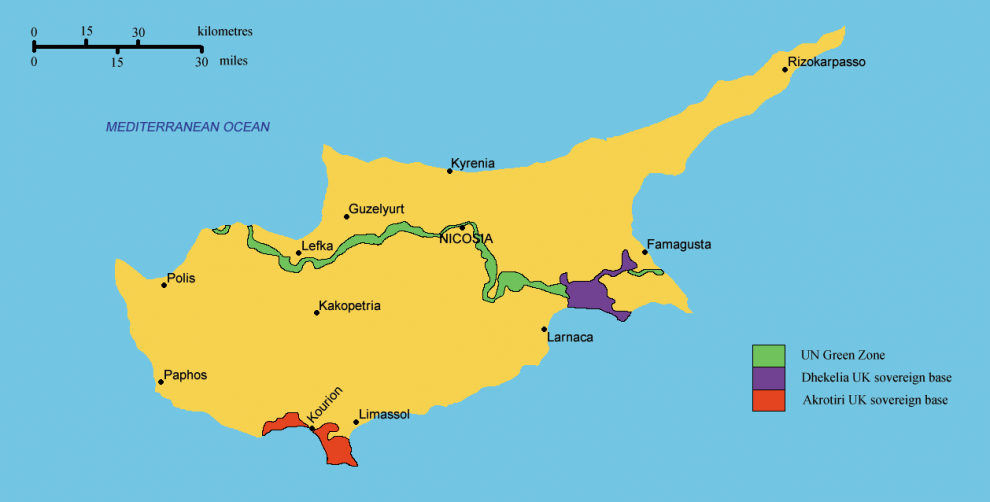
In the middle of Cyprus lies the capital city of Nicosia with a population of 200,000. The Green Line zone cuts across it, dividing it into the northern and southern parts much like Berlin was divided into western and eastern parts. While passing through the city, the zone is narrowed to just a few tens of meters. (This can be seen in Google Maps.)
There are villages inside the buffer zone, with a total population of 10,000. The eastern part of the zone is occupied by a British military base (shown in purple), presumably to ensure peace and enforce the buffer. On the West end, the zone has sea access with the shoreline of 1km long. On the East end, it also has sea access with shoreline of 500 meters long.
Britain spends money to sustain the military base. If a new country is formed in the buffer zone, then Britain can save that money and relieve its soldiers. The new country would need to continue enforcing separation of the north and south, which may put a limitation on the country’s open border policy. However, the new country would create new economic opportunities for southerners and northerners, since it will be a trading middle man. Joseph Avatar writes that it’s desirable that the new country will have a “mother” country. Britain would be that mother country, since it would be handing over control of the zone to the new country.
Cyprus is a major financial offshore zone, a tax haven, holding billions of dollars in the banks. Account holders could be incentivized to redirect these funds as investments into the new developing country. The zone has ghost towns and abandoned buildings. This is good for small startup companies, because it is easier to renovate buildings than to build from scratch.
Although there is not much land for agriculture, food can be obtained from trade with the rest of Cyprus, or by sea from other Mediterranean countries. Once the British military base leaves, the Eastern sea access becomes more accessible.
Israel and United States would likely be allies in this enterprise, because of their opposition to Turkey. The fact that the borders of the zone are already protected by the UN helps in the initial formation of the country. The existing soldiers and infrastructure can be used to continue to protect those borders initially, and then slowly switch to an independent army.
The financial sector would also be an ally, since businessmen generally favor Capitalism and free markets. If a capitalist country is formed there, Cyprus can be known to the world as more than merely a tax haven on par with Cayman Islands, but as a legitimate place of business such as Hong Kong. Offshore businesses would be incentivized to incorporate shell companies in the new country. This will create business opportunities to the residents of the new country.
The zone can fit at least ten million people if land does not need to be reserved for agriculture. When overpopulation becomes a problem, outside exclaves can be sought. Sea steading is also an option. But these problems can be solved later. The current population of Cyprus is 1.2 million. Settlements along the southern border may join the new booming country via referendums and expand the territory.
HBL #139246
10/22/21
Stephanie Bond asks for feedback on the prospect of seasteading. Both seasteads and land would need to be defended by an army. But my layman’s view is that defending a seastead is much harder, because of underwater missile attack from a submarine. Also, a nuclear explosion underwater can cause a wave that would topple the settlement. Furthermore, because submarines are legitimately powered by nuclear engines, the attacking party can pretend that the explosion was an accident.
HBL #139260
10/23/21
I have amended my post to clarify why a country in the Cyprus buffer zone is a win-win for all parties involved. Britain is saving tax dollars, and Cypriots are selling off land they cannot use.
Also note that Greece is only an ally of the southern Cyprus. Southern Cyprus is an independent country, the Republic of Cyprus. Similarly, the northern part is not part of Turkey, but proclaims itself as an independent republic. So as long as the two republics can be convinced to sell off land, they do not need Greece’s or Turkey’s permission.
HBL #139261
10/23/21
The new country will proclaim its indignation of socialist and theocratic countries, and will encourage people to emigrate from them. This will create negative publicity and will be the incentive for military retaliation by said countries.
Also, the new country will become a financial offshore zone. Other countries will demand reporting to them details of financial transactions of their residents. This further creates an opportunity for conflict.
In summary, allied countries would need to protect the seastead, much like USA interests protect Israel.
HBL #139277
10/24/21
The approach taken by the founders of the failed Republic of Minerva should not be completely dismissed. I am referring to the cultivation of shallow seamounts into land.
Minerva failed because funds were used to build it, rather than to defend it. The location was close to Tonga, but no preparation was made to protect it from Tonga’s claims. The philosophy of absolute non-initiation of force was wrong, because it excluded the right and the need to protect the country.
Therefore, if done right, a seamount can be made to work. The cultivation of the seamount should be gradual. First by boats, then by a seastead, and finally by constructing towers similar to the Roughs Tower. When the new country starts to function, innovations in garbage disposal can be used to raise the ground above the sea.
I took some time to look for seamounts. I think it is best if the seamount is far from any country, because it diminishes the severity of claims by nearby countries. The seamount should be as shallow as possible, but not above water at low tide. Otherwise, it could be an already claimed island. Also, the seamount should have a flat top of a large area.
The Vema Seamount located 800km west from the coast of South Africa may be just far enough from the continent to avoid claims. Wikipedia states that at its shallowest point it is only 30 meters under water. It doesn’t have much of a flat top.
Several shallow seamounts are located at Chagos Archipelago, 700km south of Maldives. The largest of them is 15,000 sq. km in area. They are controlled by Britain which has a military base located on an adjacent small island. If Britain needs this land for strategic military purposes, then it may agree to sell one of the seamounts to an allied new country, offering military protection as a side effect.
Google Earth can be used to search for shallow seamounts. If the “terrain” option is enabled, then clicking a mouse at any point on the ocean shows sea level at the lower right corner of the screen. In this way I found a seamount 400km east of Bowen, Australia. It’s 75 meters under water and has a flat top of 1700 square kilometers. Latitude: 19° 6’45.22″S, Longitude: 152°17’39.85″E.
I found another seamount in the middle of the Atlantic ocean, 350 km north of Saint Hellena island controlled by Britain. Google shows that it is only 2 feet under water. It is located at latitude 12°52’51.05″S and longitude 6° 2’7.61″W. Its area is 400 square kilometers of flat top.
Finally, I found another seamount 700km north east of Hawaii, at latitude 23°45’35.05″N and longitude 166°12’41.50″W. Google shows that it is also 2 feet under water. Its flat top has area of 900 sq. km.
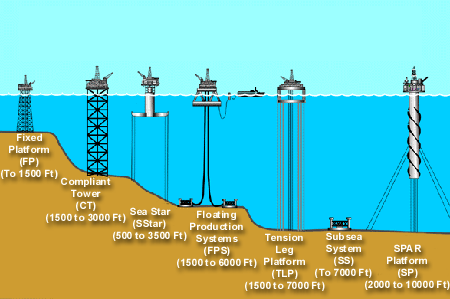
This graphic shows how ocean oil rig platforms can be fixed to the seafloor 3500 feet deep.
HBL #139411
11/06/21
British Pitcairn Islands are four islands located in the middle of the South Pacific Ocean. Their combined land is 47 square kilometers, but their current population is only 47 residents! The islands have an infamous history of child abuse. This is probably one of the reasons that no one is rushing to live there.
The largest of these islands, Henderson Island, is uninhabited but accounts for most of the territory. It has a wide shallow shore on the north and west sides which, if raised, could double the area of usable land.
Presumably Britain has an interest in this land as a potential strategic military post. I propose to buy Henderson Island from Britain and establish a new country. Britain would then be the allied “mother” country and would preserve its military interests.
HBL #139448
11/09/21
Spreading ideas actively, by propaganda, is only one of the ways to effect change. Living a life, while casually sharing one’s ideas, is another.
I want to live in capitalism during my lifetime. However, in the next 30 years Objectivist propaganda would not succeed in convincing people of an existing country to vote for capitalism. This is based on the fact that the number of Objectivists has been constant over three generations. It is possible that civilization would plunge into another millennia of darkness before an Objectivist renaissance and a rediscovery of Ayn Rand occurs.
Many Objectivists spend $5000 every year to attend OCON for the sake of social interaction. It would be a significant amount if used to propagandize Objectivism. However, OCON does not propagandize Objectivism because most who attend are already Objectivists.
I instead choose to spend $5000 per year on marketing to investors and politicians the idea of starting a new capitalist country. I cannot idly wait for Objectivism to spread by current efforts. I am not a better orator than Yaron Brook and Rucka, but even they had attracted only a small number of YouTube followers compared to other ideological speakers. I am not enough of a daydreamer to be satisfied with this success. Starting a country appears impractical when viewed in isolation. However, it’s more practical than convincing tens of millions of people.
It comes down to selfishness. Do I take a risk to possibly gain personal benefit or do I spread Objectivism for the benefit of someone who will live long after I am dead? Assuming I can’t do both, I choose the former.
HBL #140360
01/13/22
Instead of looking for a location that is uncontested and far from everything, such as the ocean, another approach is to look for a troubled area in which the presence of the new country will have benefits to all surrounding parties. The protection of the new country will be guaranteed by the balance of competing forces and interests. I gave one such example with forming a country in the Cyprus buffer zone.
Another possibility is to form a capitalist country in the Sinai peninsula. This country would be the next step of evolution of Israel. Israel would remain and continue to be the country of the Jews, the place Jews went to escape anti-semitism. I agree with Joseph Avatar with regards to what he wrote in another post: let existing countries be, and start a new one, and put it on the right foundation. In the new country people of all races and religions would coexist peacefully.
For the first few decades, the new country will be a police state: it would be impossible for terrorists to operate in it. Unlike every other country, this new country will not have a national propaganda program to make all citizens be cut from the same cloth. By private means, cultures will voluntarily segregate themselves. The police will be there to grant asylum to those who want to leave their traditions. For instance, if a young woman wants to leave Islam, she will be able to do so, and the police will be able to ensure her safety even from an on-street attack. This would be accomplished via private segregation: there would be private gated communities and roads in which muslims (for example) would be forbidden to enter. The police would assist to enforce the policy chosen by the owner, and would go to any length necessary to verify people. (Much like it is now done on flights destined to Israel, and at the entrances to Israeli consulate offices.)
Also, in this fashion, the free speech of atheists will be protected from the wrath of the religious fanatics. I know an Israeli man who openly critiqued Judaism, and he was threatened by an anonymous phone call advising him to stop.
The new country will be militarily protected by the fact that the surrounding countries will have an interest to keep it intact, since it serves their needs. For Israel, the new country is an ally because it’s Western, and also it gives a way to diffuse hostilities with Gaza and West Bank. Instead of Israel risking bringing in millions of people from those territories into its own borders, it would encourage them to move to the new country.
Egypt could be enticed to sell the Sinai peninsula to an independent country, with whom it has no prior history of war. After all, it has no funds or desire to turn the Sinai desert into a livable environment. Israel would set up the negotiations. The new country would get support from United Nations, since it would allow peaceful integration of cultures.
The new country need not occupy all of the peninsula, but can take a small part of it, as long as the area is sufficient. The engineering challenges of living in a desert are high, but modern technology can solve it given sufficient investment. But investments will come when the country is formed.
HBL #140361
01/13/22
Another idea, which I got from reading Theodore Herzl’s diary, is placing a country in the mountains. One of his arguments was that the mountain streams would provide a simple way to generate hydro-electric power. It is a valid reason even in 2020, since this permits a quick creation of startup settlements.
I also add that defense is easier on a mountain terrain than on a flat plain. (The Maccabees and later rebels hid in the mountains.) Digging caves into the mountains can further create safe spaces from an air strike attack. Whenever the country is well populated it can be defended by conventional means. However, every bit counts in the early stages.
We do not necessarily need flat land for farming and growing crops. Modern innovations in agriculture showed effective vertical crop farming. (Of course, we can import food too.)
The mountain range straddling the USA-Canadian border between Mt. Baker and Osoyoos would be a good place. It is largely uninhabited and land is cheap there. It is also close to the ocean front, and a dedicated highway may be built to a port at Blaine so that imports and exports never need to enter Canadian or USA soil. There is probably some aboriginal tribe that has claim on this land, and it could campaign for independence.
HBL #140385
01/14/22
We can’t acquire Baja California or some other place simply by offering money for it. We need to solve an impending problem that the host country cannot solve by itself. Harry correctly pointed out that there are a lot of people migrating from the Middle East to Europe, where they strain the host countries. The coronavirus situation and the BLM caused people to uproot and move again.
When a man migrates, it is usually an act of desperation. I have moved a lot in my life, and no matter how hard I tried to do it frugally, I spent an uncomfortable amount of money to make the move. Several families I know of in Vancouver, Canada moved to Florida to escape the mask-and-vaccine-passport requirements. Even when moving across first-world countries, the expense is staggering, especially when children are involved. Temporary housing (rent) in a good neighborhood, close to good schools, is expensive. Yet, people do it.
Therefore Harry is right to point out that we may be in an opportune time. On the one hand, there are a lot of unsatisfied people. We also need to identify unsatisfied countries, and solve the problem for them. Said countries will help with negotiations with UN and the host country.
I get this idea from Theodore Herzl’s diary. In 19th century the leaders of European countries had the Jewish problem on their hands. On the other hand, the citizen Jews were suffering from anti-Semitism. A new Jewish state would have solved those problems, Herzl argued. Similarly, when approaching Turkey to convince it to sell off Palestine, Herzl offered more than a lump sum of money. He tried to help Turkey solve the impending Armenian rebellion in exchange for the land deal, and also to settle Turkey’s debt with the European Control Commission (money and administration).
One cannot compromise on principles, such as that the new country must be independent, must have Capitalism. But it is the right approach to look for deals (what we mock Trump for) in order to get the land.
HBL #140401
01/15/22
I am now in a better position to answer Richard Wickline’s reservations that he expressed back in December. He states,
I estimate that Objectivists are far less numerous than the pre-World War II Zionists who started their project for the British Mandate in Palestine, with support from the United Kingdom by means of its 1917 Balfour Declaration.
Also, Objectivists are far less numerous than additional European Jews who, following World War II, fled horrors of Nazi-era persecution in Germany.
Members might think about the historical time span involved in the evolution of Zionism and the achievement in 1948 of independence for the State of Israel. The project took work across decades, spanning back to efforts of the “Father of Modern Political Zionism,” Theodor Herzl (per Wikipedia: born 1860; died 1904).
It is precisely with Theodor Herzl that I have started my research. Herzl early recognized that there are two paths: agitation of the masses or convincing influential people. He began addressing Baron Hirsch (railroad magnate), Bismarck (chancellor of Germany), and Albert Rothschild. Hirsch met him but rejected the proposal, while Bismarck did not reply to his letter (which may not even have reached him). Rothschild also didn’t reply. Next, Herzl found more accessible people (a Rabbi) with the goal to be referred to people he couldn’t reach directly. Eventually, he got hold of people of higher rank, and reached people he couldn’t earlier. After a year of this kind of networking, he was in contact with about 20 people who carried weight, and his proposed plan of creating Israel was no longer fantasy and was discussed by kings of many countries. He wanted as long as possible to keep his plan unknown and unadvertised to the masses, preferring to prepare everything in advance quietly.
Similarly, in the present case of creating a Capitalist country, only a few key people need to be reached and convinced. Yes, these key people are difficult to reach to gain an audience, but not impossible. Herzl shows how he did it. When I am ready, I plan to ask for help from Objectivists who are better connected than me for introductions.
As to the argument that there are not enough Objectivists: I have already answered this previously. In brief: not everyone who wants to move to this country (when it’s established) would be an Objectivist. We just need a sufficient number of Objectivists to ensure the integrity of the government operation to be consistent with its constitution.
HBL #140416
01/17/22
To answer Richard Wickline’s reservation about my proposal of police state: according to Wikipedia this term became associated after 1930s with authoritarian and totalitarian governments. Originally it was coined in Austria a century earlier where police was instrumental in keeping order.
Under a statist regime, a police state would disallow people to cheat and to have dissident ideas. No smoking marijuana. Perhaps a fear of police state is responsible for the concern of mass surveillance, evidenced by the Snowden affair. A character in Atlas Shrugged said: “We make regulations that are impossible not to break” (paraphrased).
But a police state in its original meaning, in the context of a Capitalist government, is not ominous. It is an arm of that impersonal robot which Ayn Rand advocated as the model for the government. In a world without fanatics, the police need only do the kind of work it does now in existing countries. However, no one today can speak out against certain topics publicly, without risking persecution of him and his family by the fanatics. In this sense, there is no free speech even in America. Since there is a lack of freedom in general (even in America), the issue curtailing free speech is not so glaring. But in a Capitalist paradise I want to create, it will be the number one issue. I want to welcome many people into the country, and they would bring their antiquated traditions with them. The country must have a viable way to protect free thinkers from fanatics who would not hesitate to impose their will by force. (I spoke in general terms, without naming. But anyone reading this can conjure examples in his mind.)
HBL #140524
01/25/22
A country can be formed even in a hot desert. While contemplating the Substeading thread started by Mr. Kyle Kirschling, I have learned about the town Coober Pedy in the Australian desert. This town, which has a population of 1700, grew to facilitate opal mining after its founding in 1915. Residents live underground in order to escape the heat. Their “apartments” have Western furniture and look civilized.
The following YouTube video is a documentary containing interviews of some residents of this town. In order to add a bedroom to an apartment, a resident would take a pick and shovel, and dig it out from sandstone. There are no rules and regulations on how one designs a home. This town is a concrete example of what happens when there is a lack of regulation and a desire by individuals (opal miners) to make an inhospitable place hospitable.
YouTube — Coober Pedy documentary
I am surprised to see that walls keep the relief of the pick, instead of being covered with drywall to make them flat and smooth. I am curious if the engineering insights gained during the growth of this town over 100 years have been recorded in literature. For example, how are floods handled?
The inhabitants of the town report that they have 22 degrees Celsius steady temperature in their apartments. I was curious to understand why the temperature is lower underground, and found this statement on Quora,
At middle latitudes the very top surface is changing temperature daily and seasonally, while further down it is about 60 Fahrenheit, an average of the above ground temperature. Past that depth, temperature increases due to heat in the earth generated through decay of radioactive isotopes.
In summary, a new country can be formed in the desert. Initial dwellings would begin underground, and later innovations would make above ground hospitable too.
HBL #140899
02/17/22
In the referenced post, Mr. Aquinas Hobor suggested Point Roberts as the place of the first Capitalist country. I spent the last four years looking to buy a house across the USA-Canadian border, and this search culminated in a purchase of one in Point Roberts. I am now making new acquaintances with the locals.
Point Roberts is a rural vacation location, in which population increases from 2,000 people to 10,000 over the summer. It is a small community in which everyone knows everyone, and people stop to chat when they walk past each other. More than half of the real estate is owned by Canadians, but none want Point Roberts to be under Canadian law. In other words, everyone is happy that the territory belongs to the United States.
Furthermore, the majority sentiment is to keep it rural and undeveloped. Owners do not want real estate prices to increase, since it would merely increase the property tax, while they have no plans of selling. To them Point Roberts is a piece of paradise, and they want to hold onto their houses.
When it comes to the principle that ideas make history, Point Roberts is a place in which it would be the easiest to spread them. It must be explained to people that under laissez-faire, their property tax will not increase with property value, and should they want to keep their houses rural, they can collude with neighbors not to sell.
My immediate plan is to start floating the idea of an independent Capitalist state during evening dinners with my Point Roberts neighbors. It would also be easy to meet in a similar unofficial capacity with the politicians representing Point Roberts.
Another issue is the soil in Point Roberts. Much like on the Canadian side, from Tsawwassen and all the way to Richmond, the soil is not a bedrock and therefore must be compacted in order to support tall buildings. As it stands now, no building in Point Roberts is taller than two stories. So if Point Roberts were to go metropolitan, in order to fit a large population, high rises would pose an engineering challenge.
I think a good model to lean on is Monaco, which has a small population. 40,000 would fit the number of Libertarians and Objectivists without any issues, without significant changes to the Point Roberts urbanization profile. Once it is an independent nation, it could work to find additional exclaves.
HBL #141586
04/04/22
My thesis continues to be that a country must be founded in a place of turmoil, where its presence would simplify the situation, and opposing interests of surrounding countries would protect its existence. Political upheavals and war offer an opportunity for gaining territory. We have seen this with the formation of Israel at the end of the First World War. It was in the interest of Britain to dislodge the Ottoman Empire, and so Britain supported the creation of a Jewish state and attacked the Ottomans.
Now there is a war in Ukraine. I am assuming that Russia will lose the war, but I project that in the aftermath, Ukraine will be depopulated. Ukrainians, especially the young generation, now have an opportunity to emigrate to better countries and to start a new life. (The countries welcoming the Ukrainian refugees made it easier to move and work there.) After the war, few will return, since they are already in a country with a better standard of living than Ukraine ever had.
In the post-war vacuum, there would be an opportunity to found a new capitalist country somewhere on the Ukrainian territory. This would most likely be the territory bordering Russia, since we already had seen two self-proclaimed republics there. Its population will be sourced from those for whom a desolate but free territory is better than their current place of living. Rejection of Russian as the universal language and preference to English will help.
Depending on the outcome of war and change of rule in Russia, Crimea too could become an independent country. Even if Putin is replaced with a non-totalitarian leader, Russia will hesitate to give Crimea back to Ukraine. Therefore, the place will continue to be under tension. Making it an independent country, independent of ethnic or nationalist interests, would pacify both sides.
Russia’s interest in Crimea is both military and economic. A capitalist country does not impede any economic activity, and would be happy to have an allied military base protecting it.